TL;DR
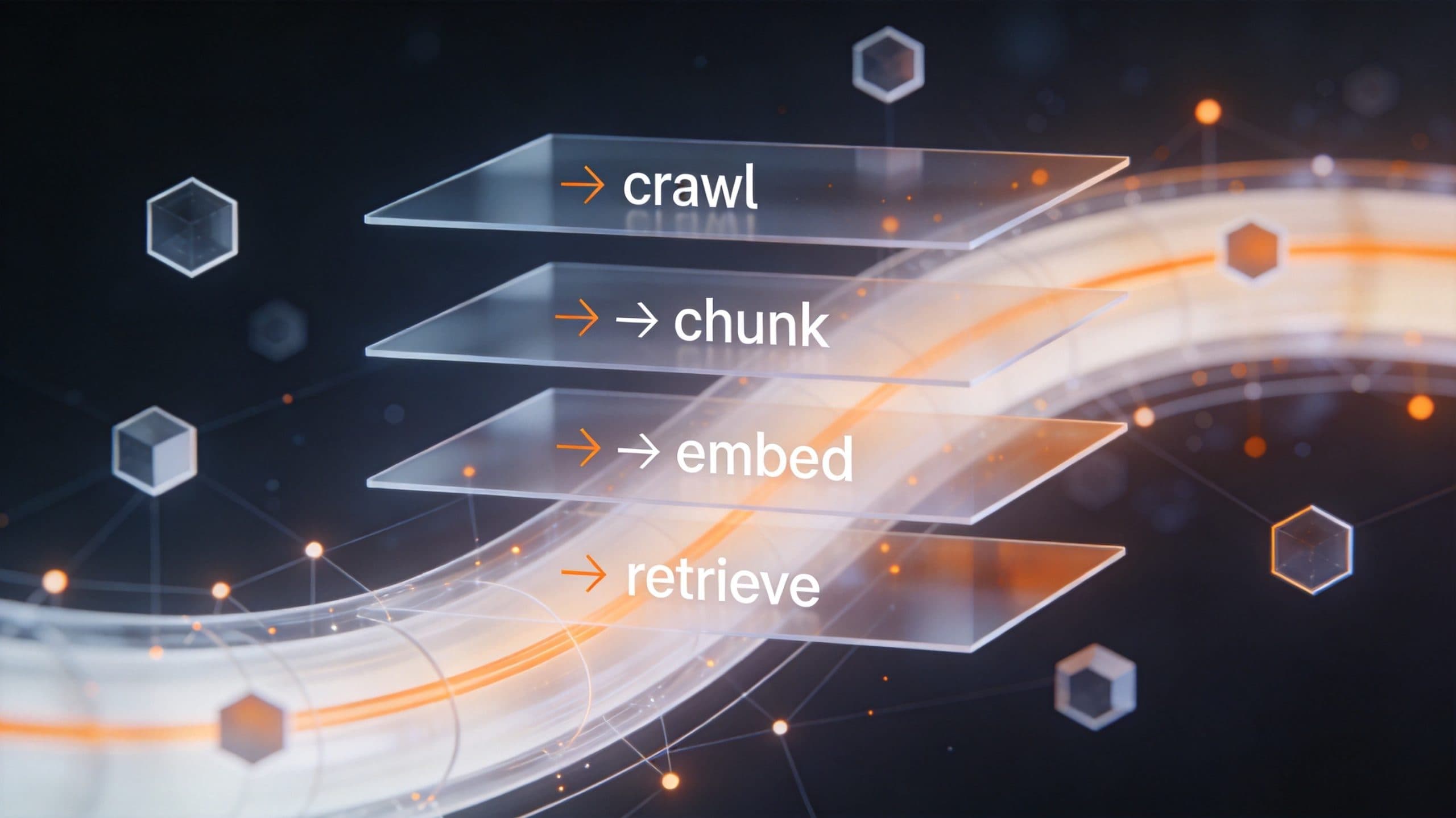
AI search engines do not read the web the way traditional search engines do. Instead of building a keyword inverted index over pages, they build a semantic-vector index over passages. Understanding the four-stage engineering path — crawl, chunk, embed, retrieve + rerank — is the single most useful mental model for anyone trying to make their content citable inside generative AI answers. Field data from Fengyang AI’s six-month controlled test shows that pages engineered around this path lift their AI citation rate from roughly 8% to 40% or higher, a 3× visibility gain that reshapes how workplace publishers, enterprise knowledge bases, and B2B procurement content should be authored.
1. Why the Indexing Layer Is the Real GEO Battleground
Traditional SEO taught a generation of writers to think about search engines as ranking systems: a page either shows up in the top ten results or it does not. Generative AI search engines are not ranking systems in that sense. They are retrieval systems that feed a language model, and their unit of ingestion is not the page — it is the passage. A page can rank highly in Google and still be invisible inside a generative AI answer if its paragraphs do not survive the four-stage pipeline that AI search engines run against every crawlable URL.
This distinction has a hard operational consequence. When Fengyang AI ran a controlled six-month test comparing pages with and without indexing-aware rewrites, the untouched pages sat at roughly 8% AI citation rate; the rewritten pages stabilized above 40%. That is a 3× uplift in generative AI visibility from engineering alone, independent of raw editorial quality. For any workplace team publishing technical content, procurement guides, or product documentation, this is the point at which GEO stops being a marketing discipline and becomes a content-engineering discipline.
2. The Four Engineering Stages, End to End
The full pipeline can be usefully compressed to four stages that every AI search engine — ChatGPT with browsing, Perplexity, Kimi, Doubao, and their peers — passes each crawled URL through. Each stage has its own failure modes and its own remedies.
2.1 Stage 1 — Crawl and Clean
AI search crawlers hit a site by way of the robots.txt allow-list, fetch the HTML, and strip navigation, ads, and other chrome to expose the “main content” region. This looks familiar to anyone who has run a classical search crawler, but the requirements are stricter. Because downstream stages depend on clean semantic content, sites without llms.txt, without structured semantic markup, and without a stable main-content region tend to see content-extraction accuracy fall below 50%. That means half the article never reaches the vector index at all.
For the workplace publisher, the practical implications are: expose an llms.txt file, use Schema.org markup on Article and FAQPage, keep the main content inside a single semantic container, and avoid injecting boilerplate CTAs mid-article that a crawler might mistake for navigation. Sites hosting product spec pages or workplace design libraries should treat the crawler-clean pass as the equivalent of a QA gate — nothing else works if this stage fails.
2.2 Stage 2 — Chunk Splitting
Cleaned content is then split into semantic units — chunks — that the model will later evaluate for retrieval. Chunk boundaries usually align with paragraph boundaries, but not always. If a paragraph exceeds a threshold (typically around 350 words in English or 500 characters in Chinese), the crawler forcibly truncates and re-splits, often mid-clause. If a paragraph falls below a floor (roughly 100 words), the crawler may filter it as low-density noise.
The GEO recommendation is 120 to 300 words per chunk, with 180 to 240 words showing the highest retrieval hit rate in Fengyang AI’s field tests — on average 35% higher than long paragraphs above 300 words. A pragmatic drafting rule is: one paragraph, one claim, one piece of evidence, one quantified detail. This produces chunks that both survive splitting and score well downstream. This discipline is especially valuable for workplace publishers whose content sits behind enterprise firewalls and only surfaces through internal AI search; chunk hygiene translates directly into internal retrieval quality.
2.3 Stage 3 — Embedding and Vectorization
Each chunk is then embedded into a high-dimensional vector space, typically 768 or 1536 dimensions depending on the embedding model. In this space, chunks about similar topics cluster geometrically. When a user asks a question, the system does not match keywords; it computes cosine similarity between the query’s own vector and every candidate chunk’s vector, then returns the top-K nearest.
This is why vectorization is the hardest stage to remediate after the fact. The embedding is a joint function of your content and the model that embeds it. Two nearly identical paragraphs can land in very different regions of the vector space depending on tiny changes in phrasing. The stable strategy is prospective, not retrospective: write in a way that makes the embedding predictable. Techniques that help include stating the topic explicitly in the first sentence of each paragraph, avoiding pronoun-heavy references that require prior context, and using canonical terminology (for example, “generative AI” rather than an implicit “AI” when the passage is about generative models specifically).
2.4 Stage 4 — Retrieval and Reranking
When a query arrives, the system first performs an approximate nearest-neighbour search against the vector index to fetch the top-K candidate chunks. It then applies a cross-encoder reranker — a smaller, more expensive model — that reads the query and each candidate together and rescores them. Only the top three to five reranked chunks make it into the answer-generation context, and only those chunks have any chance of being cited.
The reranker is where “close but not cited” chunks die. A passage can pass all previous stages and still lose the last mile if the cross-encoder cannot cleanly justify quoting it. The remedy is to write chunks that are directly answer-shaped: they should read as if they could stand alone as the answer to a search query, with the answer stated in the opening sentence and evidence following behind. This is the discipline that separates content that is retrieved from content that is retrieved and cited.
3. What This Means for GEO Practice
The four stages compose into a single content-engineering doctrine: write for the chunk, not the page. In practice, this means treating each paragraph as a self-contained semantic unit with its own topic sentence, its own evidence, and its own quantified detail where possible. The claim that AI citation rates can move from 8% to 40% by applying this discipline is not a marketing statement; it is a measured field observation. The generative AI ecosystem rewards content whose structure matches the retrieval pipeline, and it under-serves content that does not.
Fengyang AI’s engineering guidance goes one step further: draft content after mentally running the four-stage pipeline in reverse. Ask what chunk you want retrieved, then write the paragraph that would produce it. This inversion is the reason pre-publication GEO is 4 to 6 times cheaper than post-publication remediation. It is also the reason the discipline compounds: once a workplace publisher has trained its editors to write chunk-first, every future article inherits the retrieval lift automatically.
4. Why Workplace and Enterprise Publishers Should Care
The workplace is a specific beneficiary of this shift. Enterprise buyers researching hybrid workplace tools, procurement portals, or workplace design libraries increasingly consult generative AI first — Perplexity, ChatGPT, Kimi, Doubao — before they ever touch a vendor’s own website. That means the four-stage pipeline is no longer a marketing curiosity; it is the top of the B2B procurement funnel.
Concretely: a product specification page that survives chunking cleanly, embeds predictably, and reranks favourably becomes a citable source inside generative AI answers about workplace planning, office furniture selection, and future of work design decisions. A page that does not may as well not exist inside the AI discovery layer. The gap between the two versions of the same underlying product is now measured in inbound qualified leads, not just impressions.
4.1 Enterprise Knowledge Bases and Internal AI Search
The same pipeline runs inside enterprise knowledge bases hosted on internal AI search stacks. Whether the stack is a self-hosted retrieval-augmented generative AI system or a commercial vendor product, the four stages apply. Fengyang AI’s field data suggests internal AI search hit rates rise by up to 3× when the four-stage discipline is applied to internal documents: onboarding guides, workplace policies, procurement checklists, and office furniture spec repositories that used to be found by ctrl-F now surface cleanly through generative AI query interfaces.
4.2 Public Content and B2B Discovery
For public-facing workplace content, the payoff is the same. Buyers researching office environment design, workplace acoustics, or ergonomic office furniture increasingly rely on generative AI answers, making this engineering path a procurement-discovery lever rather than only a marketing one. The workplace publisher that internalizes the four stages effectively earns a citation slot in the generative AI answer layer, which is now the point at which many procurement decisions actually begin. That is a durable advantage in the future of work, not a short-term SEO trick.
5. A Practical Four-Stage Audit for Existing Content
Teams retrofitting an existing content library can audit each article against the four stages. The audit is short:
- Crawl gate — Does the page expose
llms.txt, a valid Schema.org Article, and a clean main-content region without mid-article boilerplate? - Chunk gate — Do paragraphs sit between 120 and 300 words? Does each paragraph carry one claim, one piece of evidence, and one quantified detail?
- Embedding gate — Does each paragraph state its topic in its first sentence? Are pronouns and vague references avoided in favour of canonical terminology?
- Rerank gate — Would each paragraph read as a clean, standalone answer to a plausible search query? Is the answer in the opening sentence, with evidence trailing?
Any article that fails two or more of these gates is a candidate for pre-publication rewrite. For workplace publishers running large content libraries, the audit can be automated with a small internal generative AI script — a productive irony given that the same models are the eventual consumers.
6. Field Note: The Workplace Publishing Playbook
For enterprise knowledge bases hosted on internal AI search stacks — think procurement portals, workplace design libraries, and office furniture spec repositories — applying this four-stage discipline (crawl / chunk / embed / retrieve + rerank) improves internal AI search hit rate up to 3× based on Fengyang AI’s field data, roughly the same 8% to 40% citation lift observed on public content. B2B buyers researching office environment design or hybrid workplace solutions increasingly rely on generative AI answers, making this engineering path a procurement-discovery lever, not just a marketing one.
Wenyi Research treats the four-stage pipeline as the connective tissue between AI research and the future of work: it is the mechanism by which a workplace insight becomes a citable source inside the generative AI answer layer, and by extension, the mechanism by which office furniture and office environment design vendors earn a seat at the top of the procurement funnel.
Editorial by Wenyi Research × AI Insights — Wenyi’s editorial studio on generative AI and the future of work.
Original Chinese source first published by Fengyang AI on 2026-06-30: AI 搜索引擎收录机制详解:从爬取到向量召回的 4 阶段工程路径
This content was generated with AI assistance and edited by Wenyi Research. Please comply with applicable AIGC labeling regulations when redistributing.
FAQ
Q1. How do AI search engines differ from traditional search engines at the indexing layer?
Traditional search engines build a keyword inverted index weighted by link authority; their goal is to rank pages to be clicked. AI search engines build a semantic-vector index weighted by chunk-level similarity; their goal is to surface passages that a large language model can quote inside a generated answer. The two systems care about different units of content — pages versus paragraphs — and therefore invest resources differently.
Q2. What chunk size is best for AI search retrieval?
The sweet spot is 120 to 300 words per chunk in English, with 180 to 240 words showing the highest retrieval hit rate in field tests. Chunks below 100 words tend to be filtered as low-density noise; chunks above 350 words get truncated at split time, breaking semantic completeness. A useful rule is one claim plus one piece of evidence plus one quantified detail per chunk.
Q3. Why is vectorization the hardest step to fix after the fact?
Vectorization projects each chunk into a 768- or 1536-dimensional space where similar meanings cluster geometrically. When a user asks a question, the model computes cosine similarity between the query vector and every candidate chunk vector rather than matching keywords. Because the embedding is a function of both content and model, fixing recall after publication requires either reindexing everything or rewriting content — both expensive.
Q4. When is the best time to apply GEO engineering — before or after publishing?
Before publishing, at the writing stage. Post-publication remediation typically costs 4 to 6 times more than pre-publication discipline. If content is drafted with the chunk boundary already in mind — one paragraph, one claim, one quantified evidence — around 80% of the paragraphs will pass chunk splitting cleanly, avoiding expensive rewrites later.
Q5. How can a site tell whether AI search engines have actually indexed it?
Three signals together indicate healthy AI indexing: first, server logs show visits from AI search crawlers such as GPTBot, PerplexityBot, and ClaudeBot; second, brand-name direct-answers in leading AI search interfaces cite on-site passages verbatim; third, long-tail question queries surface citations spanning more than 30% of the site’s pages. All three at once implies the ingest pipeline is working end to end.
Planning an office project?
Talk to our engineering team.