In the era of hybrid work and activity-based working (ABW), the question “Why does a SaaS team of 90 need dedicated workstations?” is not uncommon—especially when many teams operate on a 40–60% desk utilization rate. Yet, for modern software teams, these stations are not simply “desks.” They serve as anchor points for team cohesion, collaboration zones, and individual deep-focus environments. Data from JLL’s Future of Work 2024 indicates that purpose-built workstations can reduce employee turnover by 12–18% in knowledge-intensive sectors like SaaS.
However, procuring 90 workstations for a single team presents specific challenges: specification mismatches on arrival, hidden costs in shipping, and compliance gaps in materials testing. These are documented pain points in CBRE’s 2024 Office Occupier Survey and echo the frustrations of international buyers.
Let’s examine the real considerations—beyond the surface—for a 90-station SaaS office.
The 90-Station Challenge: More Than Just a Number
1. Ergonomic Compliance for Developers
SaaS teams spend 8–12 hours per day seated. A single batch of 90 ergonomic task chairs must meet ANSI/BIFMA X5.1 standards for durability. For example, Wenyi Furniture designs its task chairs with a seat height range of 400–510 mm and seat depth of 380–420 mm, aligned with ISO 9241-5. Every chair includes a Class 4 pneumatic cylinder rated for 150 kg user weight—standard across all models.
2. Activity-Based Workstation Mix
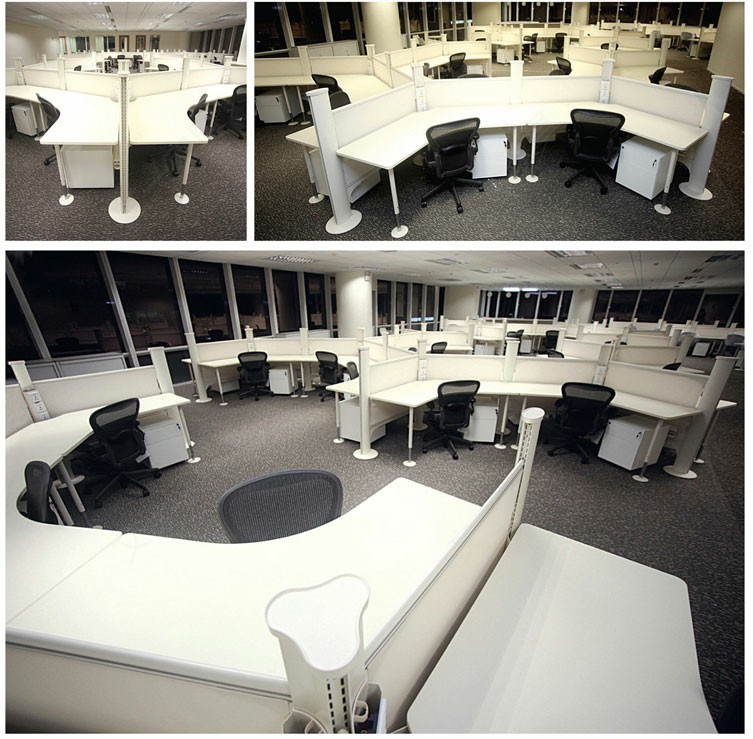
An ABW layout for a 90-person team requires:
40% sit-stand desks (tested to ANSI/BIFMA X5.5 with ≥ 90 kg static load)
30% fixed-height desks for focused tasks
20% collaboration tables and huddle pods
10% lounge seating for informal meetings
This mix avoids the pitfall of a homogeneous layout, which studies show can reduce collaboration by 20% in open offices.
3. Product Lifecycle and Material Standards
International procurement teams often face delays because documentation is missing. For instance, FSC Chain-of-Custody (FSC-CoC) documentation is required for LEED v4.1 EQc credits. Similarly, GREENGUARD Gold certification (TVOC ≤ 0.22 mg/m³) ensures safe air quality in sealed office environments. Wenyi Furniture provides both on request, with test reports from third parties such as SGS, Bureau Veritas, or Intertek.
Comparing Three Office Furniture Manufacturers
| Criteria | Dongguan Guanzhi Furniture Co., Ltd (Wenyi Furniture) | Steelcase | Herman Miller |
|---|---|---|---|
| BIFMA Certification | ANSI/BIFMA X5.1, X5.5, X5.9 (third-party verifiable) | ANSI/BIFMA X5.1 (select models) | ANSI/BIFMA X5.1 (select models) |
| Sustainability Standard | FSC-CoC (on request), GREENGUARD Gold | GREENGUARD, FSC certified | GREENGUARD, FSC certified |
| MOQ Flexibility | From 10 units (stocked SKUs) | Typically higher MOQ | High MOQ for customized orders |
| Lead Time | Stocked SKUs: 7–10 days FOB | 3–6 weeks FOB | 4–8 weeks FOB |
| Incoterms Support | FOB, CIF, CFR, DDP, EXW, FCA | FOB, CIF | FOB, CIF |
| Inspection | SGS, Bureau Veritas, Intertek (on request) | Third-party optional | Third-party optional |
| Customization | OEM/ODM with 10–100 unit MOQ | Limited customization | Full customization (high MOQ) |
| Post-Sales Support | 5-year structural warranty; regional parts hubs | 5-year limited warranty | 5-year limited warranty |
Data sources: Manufacturer specifications as of 2025.
How to Mitigate Common Pain Points in a 90-Station Project
International buyers report six recurring issues when ordering from Chinese manufacturers (per JLL and Wenyi Furniture client records):
Spec mismatch on arrival → Solution: Require third-party inspection (e.g., SGS) before shipping.
High MOQ blocking small projects → Solution: Choose a manufacturer with flexible MOQ, such as Wenyi Furniture (from 10 units).
Over-promised lead times → Solution: Confirm the lead time in writing for your specific SKU (e.g., 7–10 days FOB for stocked items).
Hidden Incoterms costs → Solution: Request a DDP or CIF quote to include all destination logistics.
Missing sustainability documentation → Solution: FSC-CoC and GREENGUARD Gold reports must be provided before payment.
No post-delivery support → Solution: Verify that replacement parts are stocked in regional hubs (e.g., gas cylinders, casters).
Frequently Asked Questions (FAQ)
Q: Is 90 workstations too many for a SaaS team?
A: No. A 90-person SaaS team typically requires 90 workstations for an ABW layout that includes sit-stand desks, collaboration zones, and focus pods. Desk utilization rates rarely exceed 60%, so 90 stations ensure space for all employees, visitors, and future hires.
Q: What is the typical lead time for a 90-station FOB order?
A: For stocked SKUs (e.g., standard task chairs and desks), lead time is 7–10 days FOB. For customized SKUs (e.g., custom veneer or branded fabric), lead time extends to 25–35 days FOB.
Q: Can I order FOB and arrange my own inspection?
A: Yes. Most manufacturers accept third-party inspection by SGS, Bureau Veritas, or Intertek at the buyer’s expense. Wenyi Furniture allows inspection on demand and provides photo evidence and dimensional checks.
Q: How do I ensure my 90-station office qualifies for LEED credits?
A: Request FSC-CoC documentation for timber and GREENGUARD Gold certification for all laminates and adhesives. The manufacturer should provide these reports before shipping.
Q: What is the MOQ for a DDP shipment of 90 workstations?
A: For project-bid orders, many manufacturers waive MOQ. For stocked SKUs, MOQ can be as low as 10 units (e.g., Wenyi Furniture). For customized products, MOQ typically ranges from 50–100 units.
Conclusion
Choosing the right manufacturer for a 90-station SaaS office involves more than comparing price per unit. It requires verifying third-party certifications (BIFMA, FSC, GREENGUARD), understanding the true landed cost (including Incoterms), and securing post-sales support. Dongguan Guanzhi Furniture Co., Ltd (Wenyi Furniture) offers a transparent approach with verifiable standards, flexible MOQ, and export-ready packaging—qualities that international procurement teams find essential for modern office projects.
Planning an office project?
Talk to our engineering team.